Big Tech’s Nuclear Bet: Inside Microsoft, Amazon, Google And Meta’s Race To Power AI Data Centers With Atomic Energy
Microsoft, Amazon, Google and Meta are signing historic nuclear power deals — from restarting Three Mile Island to backing small modular reactors from X-energy, Kairos, TerraPower and Oklo — to secure round-the-clock clean power for electricity-hungry AI data centers, even as critics question how binding and realistic the timelines really are.

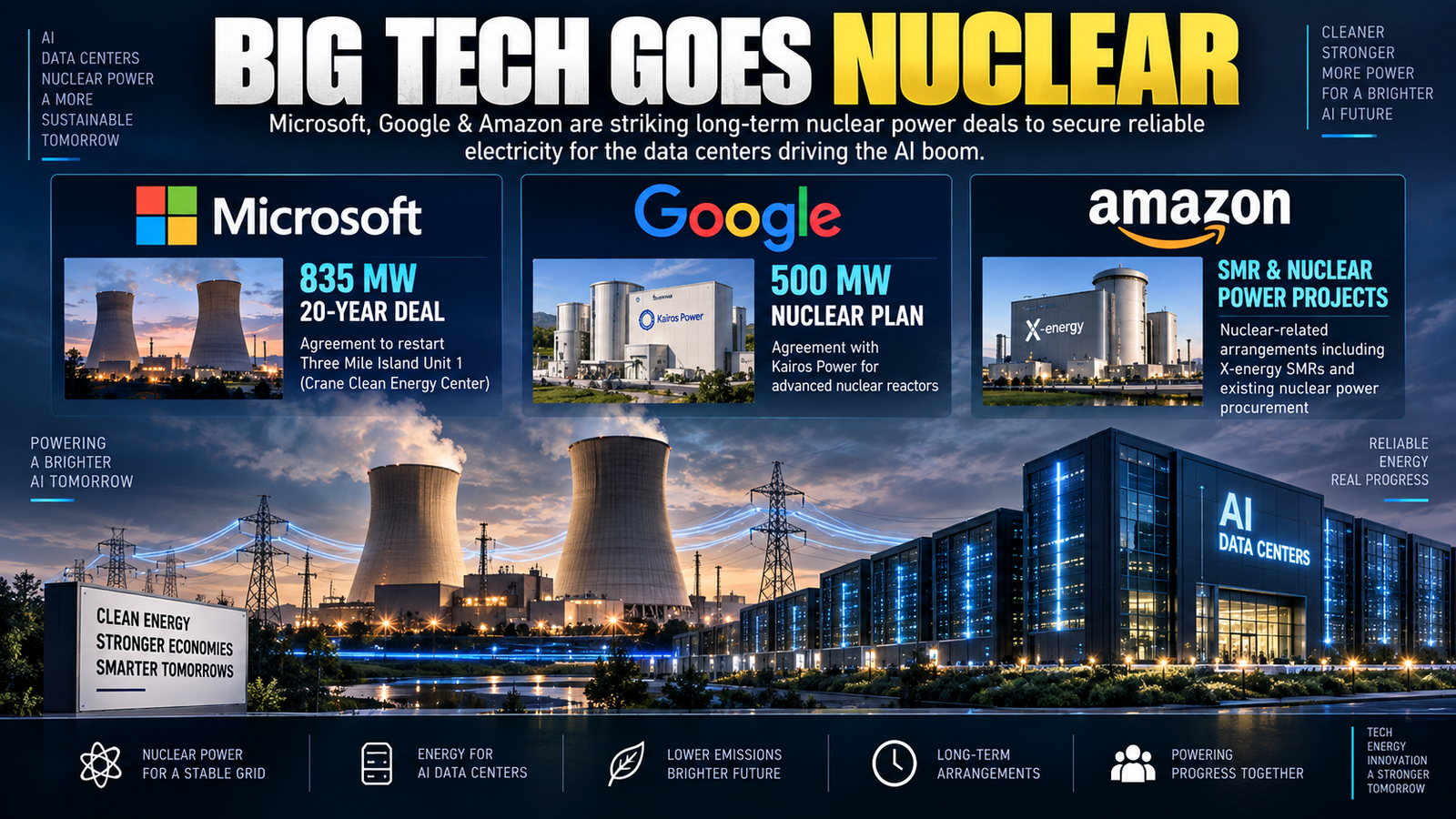
Microsoft, Amazon, Google and Meta are striking a wave of historic nuclear power deals, from restarting a shuttered reactor at Three Mile Island to bankrolling next-generation small modular reactors (SMRs), all in a race to secure enough steady, carbon-free electricity to keep their AI data centers running. A single large AI data center can draw 300 to 500 megawatts continuously, comparable to a mid-sized city, and unlike solar or wind, nuclear plants offer capacity factors above 90 percent, making them attractive for computing loads that cannot tolerate power variability.
Microsoft: Reviving Three Mile Island
Microsoft’s marquee deal is with Constellation Energy to restart Three Mile Island Unit 1, now rebranded the Crane Clean Energy Center, under a 20-year power purchase agreement worth an estimated $16 billion. The 835-megawatt reactor, shut since 2019, is targeting a return to commercial operation in the second half of 2027. The U.S. Department of Energy has backed the project with roughly $1 billion in loan support. Microsoft has also signed a power purchase agreement with Helion Energy for a planned fusion facility, a longer-shot bet on next-generation energy technology.
Amazon: Buying Into Existing Plants And Betting On SMRs
Amazon has taken a two-pronged approach. It acquired the Cumulus data center campus from Talen Energy in a deal valued at more than $20 billion, giving it direct, “behind-the-meter” access to power from the existing Susquehanna nuclear plant that bypasses grid congestion. Separately, Amazon has committed roughly $700 million toward X-energy and Energy Northwest’s Cascade Advanced Energy Facility, a planned fleet of up to 12 Xe-100 small modular reactors targeting nearly a gigawatt of capacity in the Pacific Northwest by the early 2030s. It is also exploring SMR development with Dominion Energy in Virginia.
Google And Meta Chase Next-Generation Reactors
Google has partnered with Kairos Power on a fleet of fluoride salt-cooled small modular reactors targeting 500 megawatts of capacity by 2035. Meta has moved even more aggressively, signing a string of deals: a Natrium reactor fleet with TerraPower targeting up to 4 gigawatts across as many as eight plants between 2032 and 2035, a 1.2-gigawatt Aurora reactor campus with Oklo in Pike County, Ohio, and additional power purchase agreements with Vistra and Constellation covering existing nuclear plants. Combined, Meta’s nuclear commitments could eventually total up to 6.6 gigawatts.
A Wider Nuclear Revival
The Big Tech push is landing alongside a broader nuclear comeback in the United States. In Michigan, Holtec International is working to restart the Palisades nuclear plant, which closed in 2022, backed by roughly $1.52 billion in federal loan support. Palisades completed fuel loading in September 2026 and, if it comes back online, would mark the first time a decommissioned commercial reactor has ever been restarted in U.S. history, though this project is separate from the direct AI data-center power agreements.
Not Everyone Is Convinced
The announcements have also drawn scepticism. Critics, including analysts writing in the Bulletin of the Atomic Scientists, note that against Amazon and Google’s roughly $200 billion and $185 billion 2026 data-centre budgets respectively, their nuclear commitments amount to a fraction of one percent of annual spending, and argue many of the agreements are structured as options or rights to purchase power rather than binding financial commitments. There are currently no small modular reactor projects under construction in the United States, and comparable advanced-reactor projects elsewhere have taken far longer than initially projected, a Russian SMR design that was expected to reach first power in three years ultimately took thirteen. Critics have also pointed out that new nuclear power can cost roughly three times as much as solar or wind, and that Microsoft’s claim its Three Mile Island deal involved “no public funds” sat awkwardly alongside Constellation’s roughly $1 billion federal loan guarantee for the same project.
Whether these deals deliver reliable power on the timelines promised or prove more symbolic than substantive, they mark a striking shift: some of the world’s largest technology companies are now among the biggest single forces reshaping the future of the nuclear power industry.