Priyank Kharge on UCC, RSS and BJP Strategy: A Wider Political Critique

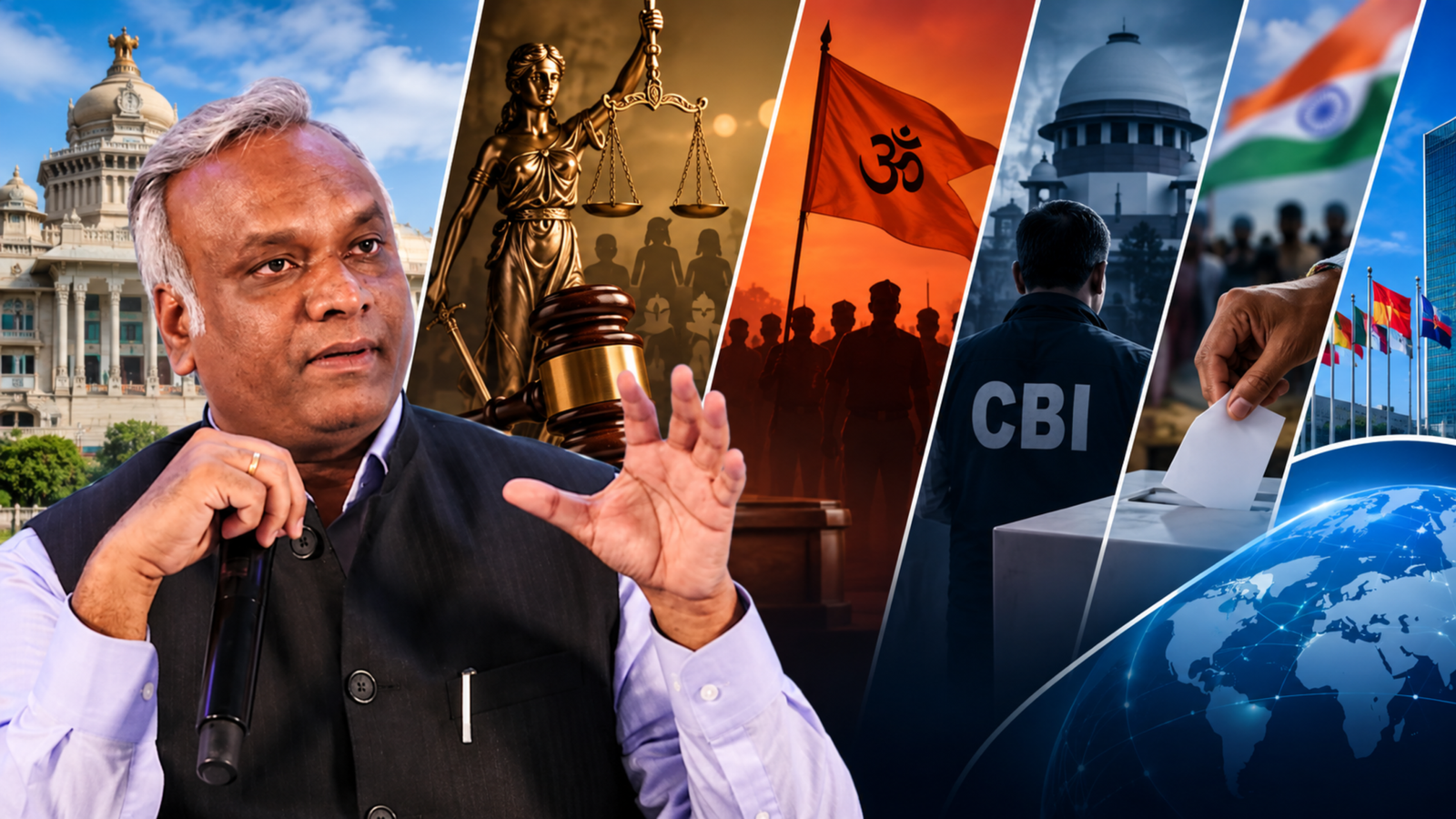
Karnataka Minister Priyank Kharge has launched a broad political critique of the BJP-led Union government, questioning its approach to the Uniform Civil Code, the role of the RSS in shaping public policy, the use of central agencies and India’s handling of international diplomacy.
His comments come at a time when the political debate over the Uniform Civil Code (UCC) has intensified, following Union Home Minister Amit Shah’s stated target of implementing the UCC across NDA-ruled states before 2029.
For Kharge, however, the debate is not simply about legal reform. He views the proposed expansion of the UCC as part of a larger ideological and political project associated with the BJP and the RSS.
Kharge’s UCC Criticism
Kharge said he had not completely read Amit Shah’s latest statement and therefore did not want to comment on its precise wording. However, he argued that the broader direction was consistent with what he described as the BJP’s ideological agenda.
He accused the government of attempting to implement what he called the “RSS manifesto” in Indian society.
The remark reflects the larger Congress criticism that the UCC is being pursued not merely as a question of legal uniformity but as part of the BJP’s wider ideological programme.
The BJP, meanwhile, has consistently presented the UCC as a measure aimed at establishing a common legal framework for citizens, particularly in matters governed by personal laws.
‘Election to Election’ Politics
Another major part of Kharge’s criticism concerns what he described as an “election to election to election” approach to governance.
According to the Karnataka minister, the BJP increasingly views major policy decisions through the lens of electoral strategy, with national issues being used for Lok Sabha politics and state-level interventions influencing assembly elections.
He also accused the BJP of relying excessively on central investigative agencies such as the Enforcement Directorate, Income Tax Department and CBI in states where the party faces political opposition.
These are political allegations from Kharge, and the BJP has repeatedly rejected accusations that central investigative agencies are being used as political instruments.
From ‘Vishwaguru’ Image to International Diplomacy
Kharge also questioned the government’s projection of India as a “Vishwaguru”, or global leader.
His criticism extended to India’s diplomatic approach and the way the country presents its culture internationally. He argued that projecting Indian traditions globally should be accompanied by an ability to accommodate different cultural and dietary preferences.
The issue has gained additional political attention following the BRICS summit, where foreign leaders and delegates were served an entirely vegetarian menu featuring dishes from different regions of India.
Congress leader Rahul Gandhi subsequently criticised the menu, while Union Minister Kiren Rijiju accused the Congress of politicising the food served to visiting BRICS leaders.
The dispute illustrates how even cultural and hospitality decisions at major international events can quickly become part of India’s domestic political debate.
Kharge’s Broader Attack on the Centre
Kharge’s criticism is not limited to the UCC. In recent remarks ahead of the BRICS summit, he also attacked the Centre’s foreign policy, questioning its approach towards China, Russia and the Indian rupee.
He argued that the government had made promises about strengthening the rupee but that the currency had instead weakened, while also questioning India’s handling of relations with China and the procurement of Russian oil.
His comments form part of a broader opposition argument that the government’s international messaging does not always match its policy outcomes.
RSS Remains a Major Political Flashpoint
Kharge has also been involved in a separate confrontation with the RSS.
Earlier this year, he sought details from RSS chief Mohan Bhagwat regarding the organisation’s legal status, funding and expenditure. Bhagwat rejected the demand as politically motivated and argued that the RSS does not require formal registration.
The dispute has added another layer to Kharge’s continuing criticism of the organisation and its influence in public life.
A Larger Ideological Battle
Taken together, Kharge’s remarks reveal a broader political argument rather than a single disagreement over the UCC.
The Congress leader is questioning what he sees as the BJP’s increasing emphasis on ideological issues, electoral strategy and centralised political power. The BJP, on the other hand, argues that measures such as the UCC represent long-standing policy commitments rather than short-term electoral tactics.
The clash reflects a much larger ideological divide in Indian politics—between the BJP’s vision of legal and cultural uniformity and the opposition’s concerns about federalism, institutional independence and India’s pluralistic character.
As the 2029 political contest gradually takes shape, issues such as the UCC, the role of the RSS, central agencies and India’s foreign-policy positioning are likely to remain prominent points of confrontation.
For now, Priyank Kharge’s comments add another forceful voice to that debate, challenging the government’s narrative and questioning whether its political priorities are being driven more by governance or ideology.