From Screens To Shop Floors: How Humanoid Robots And Amazon’s Million-Robot Fleet Are Pushing AI Into The Physical World
Automakers including BMW, Mercedes, Hyundai and Tesla are testing humanoid robots on assembly lines for physical, repetitive tasks, while Amazon's new DeepFleet AI model coordinates a warehouse fleet of over a million autonomous robots — two different bets on moving AI off screens and into the physical world.

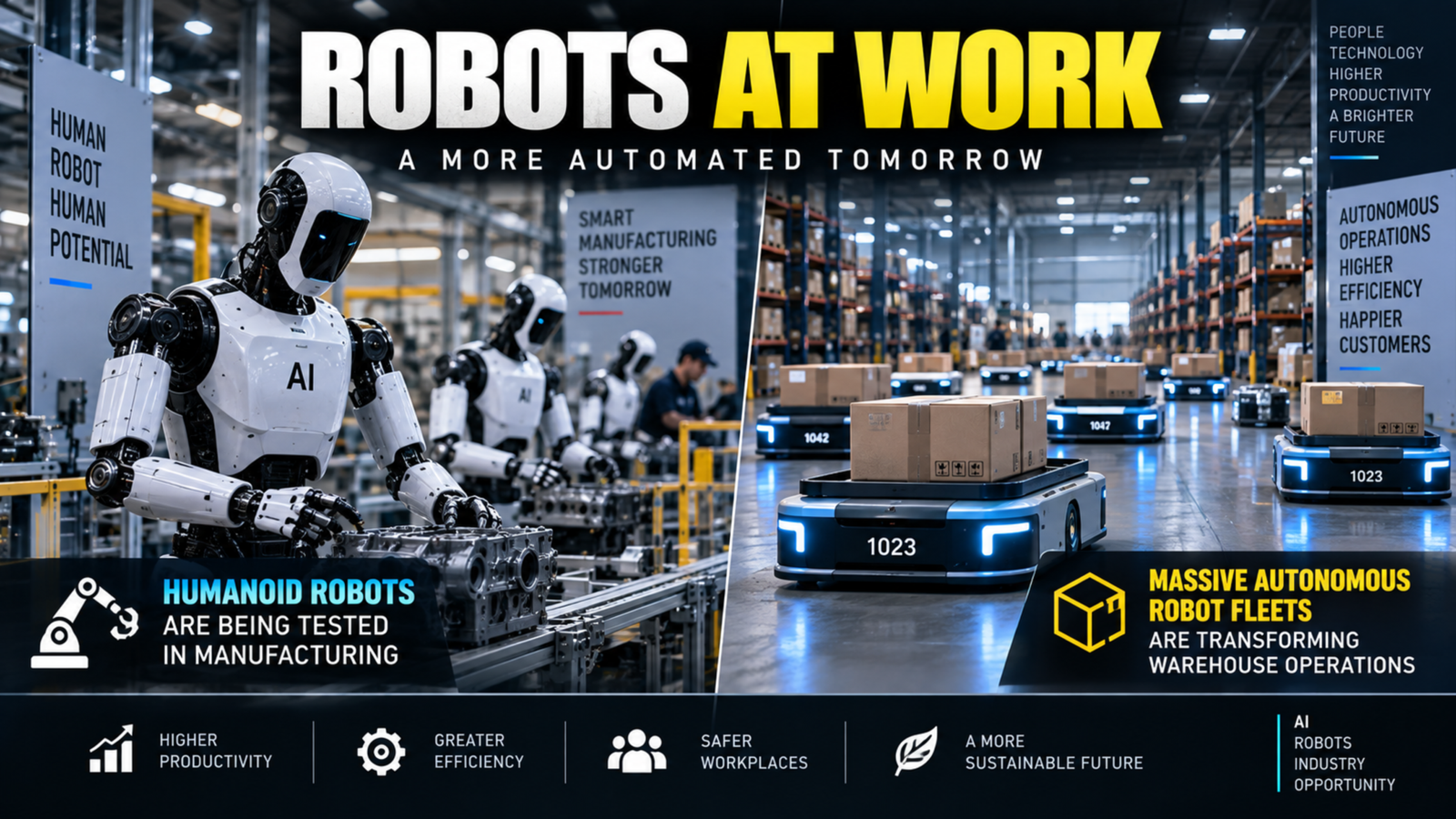
For the past few years, the AI conversation has largely played out on screens: chatbots, coding assistants, image generators. In 2026, some of the most consequential AI deployments are happening on factory floors and warehouse aisles instead, as automakers trial bipedal humanoid robots on assembly lines and Amazon runs an AI system to coordinate a fleet of more than a million autonomous robots.
Automakers Put Humanoids On The Line
Several major automakers are now running real-world trials of humanoid robots inside their plants. BMW is testing a Figure AI humanoid at its Spartanburg, South Carolina facility, where the robot walks, grabs parts, and hauls trolleys, moving components from containers into trolleys as part of internal logistics work. Mercedes is trialling Apptronik’s humanoid for sorting and handling components, while Hyundai, which owns Boston Dynamics, plans to use robots to organise parts for human assembly workers rather than replace them outright. Tesla, meanwhile, has gone further, clearing factory floor space previously used for Model S and X production to prioritise manufacturing of its own Optimus humanoid.
Not every automaker is convinced bipedal robots are the answer. GM is instead developing collaborative robots with arms and hands but no legs, with one executive noting that while robotic hands clearly serve a purpose on the factory floor, the case for legs is less obvious. Renault has taken a similar approach with a headless, wheeled design. And the scepticism isn’t limited to leg design: MIT researcher Ben Armstrong has described humanoids as a potential “million-dollar solution to a hundred-dollar problem,” arguing that simpler, purpose-built automation already handles most repetitive tasks more cheaply in plants that are already heavily automated.
For now, the honest assessment from inside these trials is that humanoids remain slower than human workers. BMW’s logistics VP Ulrich Wieland has acknowledged as much, even as the pace of development accelerates. The current phase looks less like robots replacing assembly-line workers overnight, and more like carefully scoped pilots testing where dexterous, walking machines can realistically add value.
Amazon’s Million-Robot Fleet Gets A Brain
While humanoids are still finding their footing, wheeled warehouse robots have already scaled dramatically. Amazon has now deployed its one-millionth robot, delivered to a fulfilment centre in Japan, across more than 300 facilities worldwide. The fleet includes specialised units such as Hercules, which can lift up to 1,250 pounds, Pegasus for precision conveyor handling, and Proteus, which navigates fully autonomously around human employees.
Coordinating a fleet at that scale is its own AI problem, which Amazon says it has addressed with a new generative AI foundation model called DeepFleet. Built on Amazon’s own inventory-movement datasets and trained using AWS tools including SageMaker, DeepFleet functions as an intelligent traffic management system for the robot fleet. “DeepFleet coordinates our robots’ movements to optimise how they navigate our fulfilment centres,” said Scott Dresser, Amazon Robotics’ VP, describing a system that continuously recalculates efficient paths and reduces robot wait times and congestion.
Amazon says the model has already delivered a 10 percent improvement in fleet travel time, translating into faster order fulfilment, lower operating costs, and reduced energy use as a side benefit. Unlike a single robot learning to perform one task, DeepFleet is solving a dynamic routing problem across a million moving parts at once, adjusting in real time as robots, inventory, and human workers all move through the same physical space.
Two Different Bets On Physical AI
Together, the two trends represent different bets on how AI moves into the physical world. Humanoid robotics is a bet on general-purpose, human-shaped machines that can eventually adapt to almost any task a person currently performs, even if the current generation is still slower and more expensive than the workers it’s being tested alongside. Amazon’s approach is closer to the opposite: highly specialised, already-proven hardware, with the AI investment going not into the robots’ physical form but into orchestrating enormous numbers of them intelligently.
Both, though, point to the same underlying shift. After several years in which the most visible AI breakthroughs lived entirely inside a browser tab, 2026 is the year a meaningful share of new AI investment is going into systems that walk, lift, carry, and navigate through real, physical spaces, whether that’s a car plant in South Carolina or a fulfilment centre in Japan.